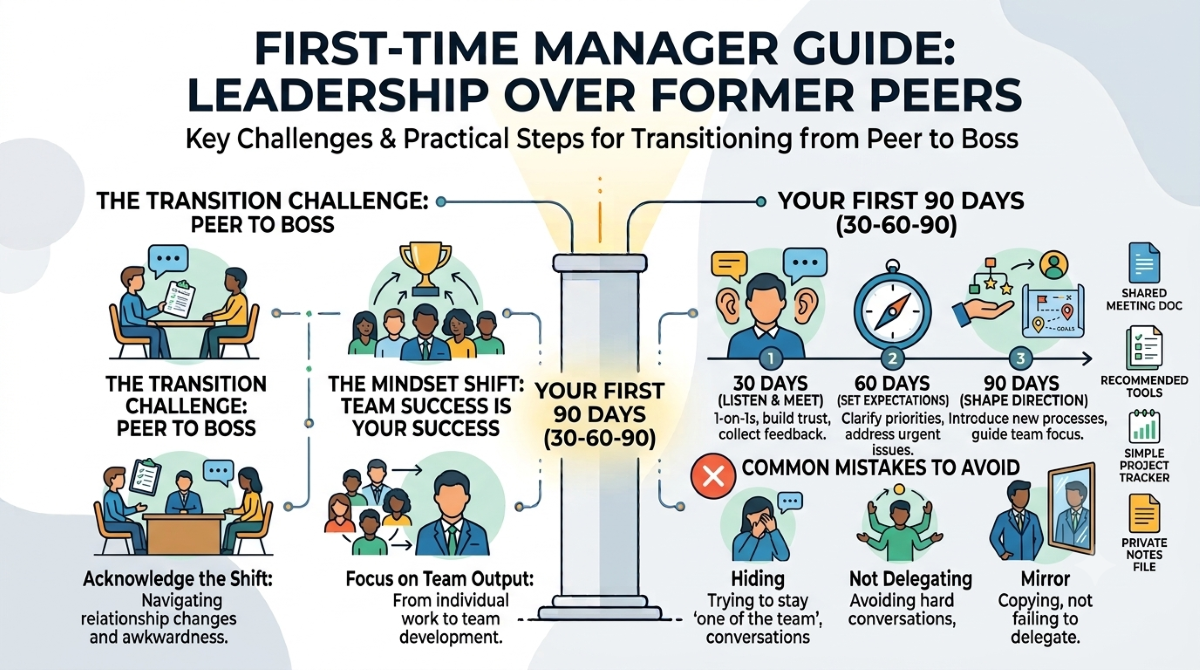
The strangest part of becoming a manager rarely shows up in any training material: the people you used to eat lunch with, vent to about deadlines, and sit beside in meetings are now people you’re responsible for evaluating, coaching, and occasionally correcting. That disorientation isn’t a sign you’re unsuited for the role — it’s close to universal, and it’s compounded by a structural problem most organizations never fix. Research from the Chartered Management Institute found that 82% of people who enter a management role have had no formal management or leadership training before starting the job. Most new managers, in other words, are figuring this out in real time, exactly as you are.
This guide is built specifically around the challenges of stepping into leadership over people who were recently your peers, with a practical structure for your first few months in the role.
The Transition Challenge: From Peer to Boss
The hardest part of this shift usually isn’t the added responsibility, it’s the relationship recalibration underneath it. Former peers may quietly test whether you’ve changed, feel awkward asking you for help they’d have asked for freely a month earlier, or expect informal exceptions because of your shared history. Meanwhile, you’re trying to be fair to everyone, including people you were never especially close to before, which can feel like betraying the friendships that got you comfortable in the first place.
None of this resolves quickly, and pretending it isn’t happening tends to make it worse. Naming the shift honestly, even briefly, with the people it affects most directly often does more to ease the tension than trying to act as though nothing has changed.
The Mindset Shift You Need to Make
Your work used to be judged by your own output. It’s now judged by your team’s output, which means your success is tied to other people’s success in a way it never was before. This is a genuine shift in what “doing the job well” means, not just a change in job title.
Some new managers resist this shift instinctively, jumping back in to do tasks themselves because it feels more productive and more familiar than developing someone else’s ability to do them. That instinct is understandable, it’s often exactly the instinct that made someone good enough at their previous job to get promoted, but it undermines the new role if it isn’t consciously interrupted. Understanding the specific traits and skills that separate good managers from average ones is a useful way to recalibrate what “doing your job well” now actually requires.
Your First 30-60-90 Days
The first month should be weighted heavily toward listening rather than acting. Meeting individually with everyone on the team, asking what’s working, what’s frustrating, and what they need most from a manager, builds the information and trust that everything else depends on. Resist the pull to make big changes immediately, even when a fix seems obvious on day three, obvious fixes sometimes turn out to be missing context you haven’t gathered yet.
By the second month, expectations should start getting sharper. At this point, the real strengths and gaps on the team are usually visible, which makes it possible to clarify priorities, resolve any ambiguous responsibilities, and address whatever surfaced most urgently during the listening phase.
The third month is when a manager can start actively shaping the team’s direction. With trust established and expectations clarified, this is a reasonable point to introduce new priorities, adjust how work gets divided, or shift the team’s overall focus, changes that would have landed as presumptuous in week one now land as informed leadership.
What New Managers Tend to Worry About Most, and What Usually Happens
The fear of being resented for “changing” once promoted is close to universal among first-time managers, and it’s usually more intense in anticipation than it turns out to be in practice. Most former peers extend more goodwill during this transition than a nervous new manager expects, provided the manager doesn’t try to pretend the relationship hasn’t shifted at all. The relationships that do struggle tend to be the ones where the new manager either overcorrects into artificial formality, or refuses to acknowledge any change and ends up avoiding the responsibilities that come with the new role.
A second common worry is the sense of being an impostor, the nagging feeling of not really knowing what you’re doing, paired with the assumption that everyone else figured this out faster or more naturally. Given that the vast majority of first-time managers enter the role without formal training, as the earlier CMI research shows, that feeling is closer to the norm than the exception. It fades with repetition, not with some threshold of confidence arriving all at once.
Common Mistakes First-Time Managers Make
Trying to remain “one of the team” is one of the most common traps, and it usually comes from a good instinct taken too far. Warmth and approachability don’t require avoiding the harder parts of the job, like delivering critical feedback or making an unpopular call, in fact, avoiding those things tends to erode the very trust a manager is trying to protect.
Avoiding difficult conversations with former peers specifically, because the history makes them feel more loaded, is another frequent pattern. Delaying feedback out of discomfort rarely makes it easier later; it usually just makes the eventual conversation carry more weight than it needed to.
Refusing to delegate is a third trap, and it’s closely tied to the mindset shift described above. Many first-time managers keep performing their old job on top of their new one, because it feels safer than trusting someone else with it, our guide to delegating without micromanaging walks through a way out of that particular trap.
Copying a former manager’s style wholesale, whether that style was good or bad, is a quieter mistake that’s easy to fall into by default. It’s worth deliberately choosing an approach rather than inheriting one, and our piece on leadership styles is a useful starting point for identifying which approach actually fits your own tendencies and the team you’ve inherited.
Building Credibility With Former Peers
Credibility in this situation comes from consistency far more than from formal authority. Transparency about decisions and the reasoning behind them tends to matter more here than in almost any other management context, precisely because former peers are watching closely for signs that power has changed how you operate. Following through on commitments, especially small ones — carries outsized weight during this period, since it’s one of the few concrete signals available that you’re the same person in a new role, not a different person entirely.
When feedback needs to happen with a former peer specifically, doing it privately, promptly, and with real specificity matters more than usual, because vague or public correction can read as a status move rather than genuine coaching. Our guide to giving feedback without damaging morale covers the mechanics of this in more depth than is practical here.
What Changes if the Team Is Remote or Hybrid
Everything above still applies, but the peer-to-boss transition carries an extra layer of difficulty when the team isn’t sharing a physical space anymore. The informal, low-stakes conversations that used to happen naturally, a quick check-in walking to lunch, a comment overheard near someone’s desk, simply don’t occur on their own in a remote setting, which means a new manager has to recreate them deliberately rather than relying on proximity to do the work. This often means scheduling shorter, more frequent, more informal check-ins than would feel necessary in person, precisely because there’s no ambient replacement for them.
The awkwardness of the peer-to-boss shift can also linger longer remotely, simply because there are fewer small, everyday moments to naturally reset the relationship. A first video call as someone’s manager, rather than their former deskmate, can feel more formal and more loaded than the equivalent in-person conversation would have. Naming that shift directly, even briefly, tends to shorten the adjustment period rather than letting it stretch out silently across several weeks of stilted calls.
Recommended Habits and Tools for the First 90 Days
A shared one-on-one document per team member, where notes and action items carry forward between conversations, prevents important context from getting lost between meetings. A simple, visible project tracker keeps priorities transparent to the whole team rather than living only in a manager’s head. A private notes file, kept just for yourself, tracking what’s working and what you want to adjust as you go, becomes genuinely useful once you look back at it after a few months and notice patterns you wouldn’t have caught in the moment.
Grieving the Old Relationship, Briefly and Honestly
There’s a version of this transition that rarely gets named directly: something genuine is lost when a peer relationship becomes a manager relationship, even when the new dynamic is ultimately healthy and even when both people handle it well. The easy camaraderie of complaining about a shared frustration together, the freedom to be uncertain out loud without it reading as a leadership gap, the simple flatness of the relationship before a hierarchy entered it, these don’t fully survive the transition, and pretending otherwise doesn’t make the loss less real.
Allowing yourself to acknowledge that briefly, rather than treating any sense of loss as evidence you’re handling the promotion badly, tends to make the adjustment period shorter, not longer. The relationship that replaces it can still be a good one, built on a different kind of respect than what came before, but it helps to let go of the expectation that it should feel exactly the same as it did before the title changed.
How Long This Actually Takes
Most first-time managers underestimate how long the full transition takes and overestimate how quickly they should feel comfortable in the role. Ninety days is enough time to establish the basics, clear expectations, a working rhythm of one-on-ones, an initial sense of the team’s real strengths and gaps, but the deeper comfort of genuinely inhabiting the role, rather than performing it, tends to take closer to a full year for most people. That’s not a sign of being behind; it’s roughly how long it takes for enough situations to repeat that patterns start to feel familiar rather than novel.
It’s worth measuring progress against your own earlier self rather than against some imagined version of a manager who has it all figured out. A first-time manager six months in who still finds performance conversations uncomfortable, but handles them anyway, is doing the job well, discomfort with a hard conversation doesn’t disappear with experience so much as it becomes something you’re willing to sit with rather than avoid.
A Common Early Scenario: A Former Peer Is Now Underperforming
One of the more difficult early tests of this transition arrives when a former peer, someone you genuinely liked working alongside, starts underperforming under your management. The instinct to give them more slack than you’d give someone else, precisely because of the history between you, is understandable but usually counterproductive, other team members tend to notice the double standard quickly, even when it’s never stated out loud, and it erodes trust in your fairness faster than almost anything else could.
The more sustainable approach is holding the same standard you’d hold for anyone else, while being honest with yourself about why the conversation feels harder in this particular case. Naming that discomfort internally, even just to yourself, often makes it easier to have the conversation cleanly rather than either avoiding it or overcorrecting into unusual harshness to prove you’re not playing favorites. The goal isn’t to treat a former peer identically to a stranger, the shared history is real and doesn’t need to be erased, but the standard of performance and the honesty of the feedback shouldn’t shift because of it.
Managing Up While You’re Still Finding Your Footing
Most of the advice a first-time manager receives focuses downward, toward the team, but the relationship with your own manager during this period deserves just as much attention. Being honest with your own boss about what feels uncertain rather than performing confidence you don’t yet have, tends to earn more trust than it costs, since most experienced managers recognize the accidental-manager pattern immediately and respect someone willing to name it rather than fake their way through.
Asking your own manager directly what “success” looks like in your first quarter, rather than assuming you already know, closes a gap that causes a surprising amount of first-time-manager anxiety. Many new managers spend their first few months guessing at expectations that were never actually stated, when a fifteen-minute conversation could have clarified them from the start. This mirrors the same principle covered earlier about setting clear expectations with your own team it applies just as directly upward as it does downward.
Where to Go From Here
The awkwardness of managing former peers fades faster than most new managers expect, usually once the first genuinely difficult conversation has been handled with fairness and a bit of grace. Focus on listening first, staying consistent under pressure, and building the specific skills that make the rest of the job easier over time. For the next piece in this series on core management skills, subscribe to our newsletter so it reaches you as soon as it’s out.
This article is part of our Leadership Fundamentals series. Related reading: What Makes a Good Manager?, Leadership Styles Explained, and Delegation 101.