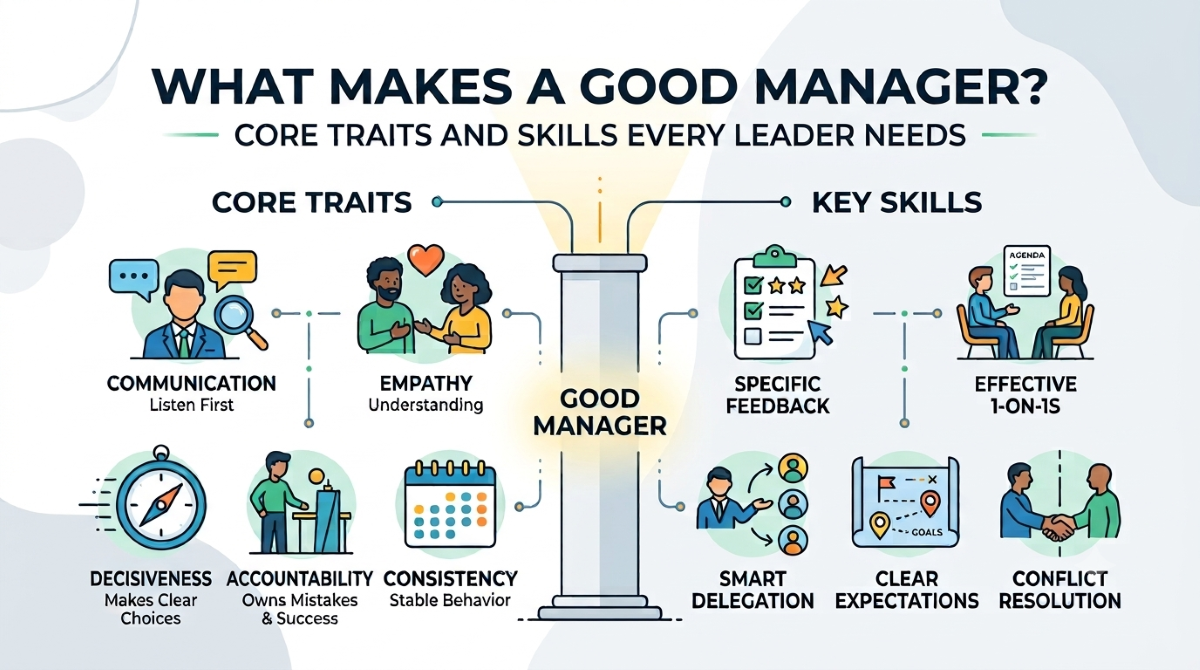
Most new managers inherit a title without inheriting a definition of what “good” actually looks like. They’re told to lead well, but nobody hands them a rubric for it. Gallup’s long-running research on workplace engagement offers one of the clearest starting points available. After analyzing engagement data across more than 100,000 teams, Gallup found that managers account for at least 70% of the variance in employee engagement scores between business units. In plain terms, the gap between a thriving team and a struggling one comes down, more than any other single factor, to who is managing it — not compensation, not office perks, not the mission statement on the wall.
That number reframes the whole question. “What makes a good manager” isn’t really about personality or charisma. It’s about identifying the specific, repeatable behaviors that produce those different outcomes, and building them deliberately, whether or not they came naturally to begin with. This guide breaks those behaviors down into the traits that shape how a manager shows up day to day, and the skills that turn those traits into results a team can actually feel. If you’re brand new to the role, pair this with our First-Time Manager Guide for the transition-specific challenges this piece doesn’t cover.
The Traits That Separate Good Managers From Average Ones
Traits are the underlying qualities that shape a manager’s daily behavior. They aren’t fixed personality types stamped on someone at birth most can be strengthened with deliberate attention, even if some people start with a natural head start.
Communication sits at the center of nearly every other trait on this list. A manager who explains the reasoning behind a decision, not just the decision itself, gives their team something to work with beyond blind compliance. This matters more than it sounds: employees who understand why a priority shifted are far more likely to adapt willingly than employees who are simply told it shifted. Good communicators also listen at least as much as they talk, treating a conversation with a direct report as an exchange rather than a briefing.
Empathy is often misunderstood as softness, but it functions more like calibration. A manager who understands what an employee is actually dealing with — a heavy personal week, an unclear handoff from another team, a skill gap they’re embarrassed to admit — can set expectations that are both fair and achievable. Empathy without follow-through is just sympathy; the trait only becomes useful when it changes how a manager actually leads.
Decisiveness matters because ambiguity is expensive. Teams lose confidence quickly in a manager who can’t commit to a direction, even when the underlying uncertainty isn’t the manager’s fault. Good managers gather enough information to make a reasonably confident call, communicate it clearly, and adjust later if new information demands it rather than leaving a team in limbo while they wait for perfect certainty that will never arrive.
Accountability cuts in two directions at once. It means holding a team to the commitments they’ve made, but it equally means owning outcomes when something goes wrong under a manager’s watch, rather than routing blame downward to whoever executed the flawed plan. Teams notice which direction their manager’s accountability flows, and it shapes how honestly they’ll report problems in the future.
Consistency is the trait that makes all the others legible over time. A manager who behaves roughly the same way on a good day and a stressful one creates a predictable environment, and predictability is a major, underrated driver of psychological safety. Employees adjust their own behavior around a manager’s mood when that mood swings unpredictably, which means inconsistency quietly costs a manager influence even when their intentions are good.
These traits also interact with a manager’s natural leadership approach. A manager who leans toward direct, task-focused instruction will express empathy differently than one who leans toward a more collaborative, discussion-driven style — see our guide to leadership styles if you want to identify your own default tendencies before reading further.
What This Looks Like in a Real Team
Consider two managers running similar teams through the same quarter, both facing an unexpected deadline pulled forward by six weeks after a client renegotiation. The first manager announces the new deadline in a team channel with no further explanation, then spends the next several weeks fielding quiet frustration and a noticeable dip in the quality of work being turned in. The second manager calls a short meeting, explains exactly why the timeline moved and what happens if the team misses it, then asks each person what would need to shift in their current workload to make the new deadline realistic. Both managers deliver the same piece of information. Only one of them treats their team as capable of absorbing a hard truth, and that difference shows up directly in how the following weeks actually go.
This is what the traits above look like once they leave the abstract. Communication isn’t a personality quirk in this scenario, it’s the difference between a team that understands the pressure it’s under and a team that just feels pressure without context. Empathy isn’t softness; it’s the reason the second manager thought to ask what needed to shift rather than assuming the team could simply absorb six weeks of lost runway without any adjustment elsewhere.
Why Traits Alone Aren’t Enough
A manager can score highly on every trait above and still struggle, because traits describe character while skills describe capability. Someone can be genuinely empathetic and still be bad at delivering feedback, simply because no one ever taught them a structure for doing it well. This distinction matters practically: skills are far easier to build on a deadline than traits are. A manager can learn a feedback framework in an afternoon. Building deeper empathy, by contrast, tends to happen more slowly, through repeated exposure to other people’s circumstances and honest reflection on past missteps.
This is the reason the strongest managers treat management as a craft worth studying, rather than a personality they either have or don’t. Traits set the ceiling on how well a skill can be executed, but skills determine whether the trait ever reaches a team in a usable form.
The Skills That Turn Traits Into Results
Feedback delivery is usually the single highest-leverage skill on this list, because it’s the mechanism through which almost every other trait becomes visible to a team. A manager can be deeply empathetic in private thought, but if that empathy never translates into clear, specific, well-timed feedback, the team experiences only the absence of guidance. Our detailed guide to giving feedback without damaging morale walks through a concrete framework for this, but the short version is that feedback needs to be specific enough to act on, delivered close to the moment it’s relevant, and framed around behavior rather than character.
Delegation is the second major skill, and it’s where accountability and trust intersect most visibly. Managers who struggle to delegate usually aren’t lazy or controlling by nature they’re often former high performers who genuinely believe, correctly in the short term, that they could do the task faster themselves. The cost of that belief compounds over time: every task a manager keeps for themselves is a task their team doesn’t get to grow into. Our full guide to delegation covers how to hand off work without either abandoning it or hovering over it.
Running a genuinely useful one-on-one meeting is a skill distinct from simply scheduling one. Many one-on-ones drift into status updates that could have been an email, rather than the space they’re meant to be for coaching, career conversations, and surfacing problems early. A manager who treats this meeting as the employee’s time, not their own status-check opportunity, tends to catch issues weeks before they’d otherwise surface.
Setting clear expectations upfront prevents a large share of the conflict and disappointment that shows up later. Vague expectations don’t fail loudly; they fail quietly, in the form of an employee who thought they were meeting the bar and a manager who thought they weren’t. Closing that gap before work begins is far cheaper than resolving it after.
Managing conflict directly, and early, is a skill many managers avoid simply because it’s uncomfortable. Left alone, small tensions between team members rarely resolve on their own they tend to either fester or explode. A manager willing to name a tension plainly, before it escalates, spares the team a much larger disruption later.
Prioritization rounds out the list, and it’s often the most underrated skill of the group. A team stretched across too many competing goals at once rarely fails because the goals were wrong; it fails because nothing had permission to be the priority. Managers who can say, clearly, what matters most this month and what can wait — give their team something they can actually act on.
How to Develop These Traits and Skills Deliberately
Self-awareness has to come first, and it’s usually less comfortable than it sounds. Asking a team directly, or anonymously if trust is still forming, what’s working and what isn’t about how they’re managed tends to surface a gap between intent and impact that most managers underestimate. It’s common to believe you communicate clearly and discover, once you ask, that your team experiences something closer to ambiguity.
Trying to overhaul everything at once rarely works, and it often backfires by making changes feel performative rather than genuine. Choosing one skill with outsized impact on the current team often feedback or delegation and working on it for a month before adding the next tends to produce change that actually sticks.
Getting outside feedback on your own feedback is one of the fastest ways to close the intent-impact gap. After a difficult conversation with a direct report, asking a trusted peer or mentor how it likely landed, based on how it was structured and delivered, often reveals blind spots that are invisible from the inside.
Studying concrete frameworks tends to produce faster improvement than absorbing general advice. “Communicate more” is nearly impossible to act on directly. A specific structure for feedback, delegation, or prioritization gives a manager something repeatable to reach for under pressure, when instinct alone tends to default back to old habits.
Common Misconceptions Worth Retiring
One persistent misconception is that good management requires a naturally extroverted, high-energy personality. In practice, some of the most effective managers are quiet, deliberate communicators whose teams trust them precisely because they don’t perform enthusiasm they don’t feel — consistency matters far more than charisma once a team has worked with someone for a few months.
Another common misconception is that being liked and being respected are the same goal, or that pursuing one automatically produces the other. They frequently pull in opposite directions in the short term. A manager who delivers a hard piece of feedback well might not feel more liked in that moment, but the respect that decision earns tends to outlast the temporary discomfort, while a manager who avoids the feedback to stay likable often erodes respect slowly and invisibly.
A third misconception is that experience alone builds these skills automatically. Years in a management role correlate with comfort in the role, but comfort and competence aren’t the same thing plenty of long-tenured managers have simply gotten used to habits that were never particularly effective, because no one ever gave them a reason to examine them closely.
A Self-Assessment Framework for New and Practicing Managers
Use this as a quick, honest gut-check rather than a formal scoring system:
- Do people on the team bring problems to you early, or do they tend to wait until something has already gone wrong?
- Can you state, in one sentence, what “good performance” looks like for each person you manage?
- When did you last give specific, non-generic feedback not just “great work” within a day or two of noticing something?
- Do you know what’s actually motivating each person on your team right now, beyond assuming it matches your own motivations?
- If your team described your leadership in one honest word, would you be comfortable with that word?
A handful of hesitant answers here isn’t a bad sign. It’s simply a starting point, and the managers who improve fastest are usually the ones willing to sit with these questions rather than answer them defensively.
A Few Specific Phrases Worth Practicing
Certain phrases tend to carry the traits above into an actual conversation more reliably than others. Opening a disagreement with “help me understand how you’re seeing this” rather than “that’s not right” keeps a conversation collaborative rather than adversarial, while still allowing a manager to redirect the discussion once they’ve genuinely heard the other perspective. Closing a difficult conversation with “what do you need from me to make this work” shifts the exchange from a one-directional correction into a shared problem, which tends to produce more ownership on the other side than a directive ever would.
When priorities shift unexpectedly, naming the trade-off explicitly “this means X has to wait, and I want to be upfront about that rather than let it quietly slip” tends to preserve trust even when the news itself is unwelcome. Teams generally forgive a manager for hard decisions far more readily than they forgive a manager for hiding the fact that a decision was even made.
How These Traits and Skills Change as Your Team Grows
The traits and skills covered here don’t change in kind as a team grows from three people to fifteen, but they do change in how much they depend on systems rather than memory. A manager of three people can track everyone’s current priorities and recent feedback in their head without much effort. A manager of twelve or fifteen cannot, and pretending otherwise usually shows up as inconsistency — clear expectations for the people a manager happens to think about most, and vaguer ones for everyone else.
This is where the habits described above start to matter structurally, not just personally. Written expectations, documented one-on-one notes, and a consistent cadence for feedback stop being nice extras and start being the only realistic way to apply these traits fairly across a larger group. A manager who was genuinely excellent at intuitive, in-the-moment feedback with a small team often needs to become more deliberate and more structured as the team scales, simply because intuition alone stops covering everyone equally once the group gets large enough.
Where to Go From Here
Good management isn’t a fixed trait some people are born with and others simply lack, it’s a set of behaviors and skills that compound with deliberate practice. Pick one area from this guide, whether that’s tightening how you deliver feedback or getting more intentional about your next one-on-one, and build from there. If you want the next piece in this series — including a deeper look at the transition from peer to manager subscribe to our newsletter and it’ll land in your inbox as soon as it’s published.
This article is part of our Leadership Fundamentals series. Related reading: First-Time Manager Guide, Leadership Styles Explained, How to Give Feedback Without Damaging Morale, and Delegation 101.