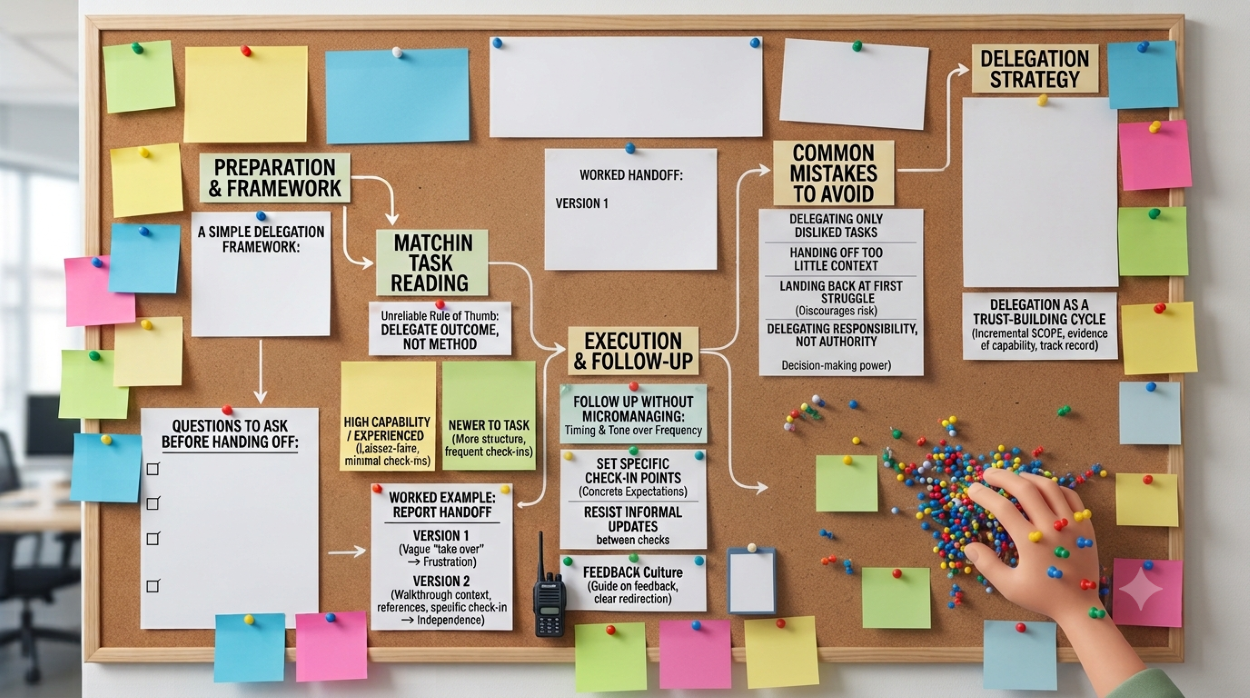
Delegation sounds simple in theory hand off a task, let someone else do it but in practice, most managers either hold on to too much themselves or delegate in a way that leaves their team confused and under-supported. The gap between those who delegate well and those who don’t shows up in results that are easy to measure. Gallup’s study of Inc. 500 CEOs found that those with high delegator talent generated 33% greater revenue than CEOs with low or limited delegation skills, alongside a substantially faster three-year growth rate. Delegation, in other words, isn’t a nice-to-have leadership habit it’s one of the more measurable drivers of what a team, or a business, is actually capable of producing.
Done well, delegation frees up a manager’s time while building their team’s capability at the same time. Done poorly, it creates more work for everyone involved than if the manager had simply kept the task.
Why Managers Avoid Delegating
A few patterns tend to explain most of the resistance. The belief that “it’s faster if I just do it myself” is often true in the short term, which is exactly what makes it such a durable trap it guarantees the manager will still be doing the task months later, having never made the short-term investment that would have freed them from it. Fear of losing control over quality is especially common among managers who were promoted for being excellent individual contributors, since letting go of hands-on execution can feel like giving up the very thing that made them good at their job. A reasonable-sounding instinct not to overload the team can also mask outdated assumptions about someone’s current capacity or skill level that haven’t been checked in a while. And without a clear framework, it’s often genuinely unclear which tasks are actually safe to hand off in the first place.
Recognizing which of these is doing the most damage in a given case is the first real step, and it often connects directly to the broader mindset shift covered in our First-Time Manager Guide the move from personally doing the work to enabling someone else to do it.
A Simple Delegation Framework
Before handing off a task, four questions tend to prevent the most common failures. What outcome does this actually need to produce the result, not just the activity that leads to it? Who has the right skill level for this task, or is close enough to grow into it with reasonable support? How much context does this person need in order to succeed working independently, rather than needing to check back repeatedly? And what’s the check-in point, along with a clear sense of what “done well” actually looks like once the task is complete?
Working through these questions upfront prevents the two most common delegation failures: handing off a task with too little context for the person to succeed, or hovering so closely afterward that the task was never really delegated in the first place.
Matching Tasks to Skill and Readiness
Not every task should be delegated the same way. A highly capable, experienced employee can often take a task with just the desired outcome stated and minimal check-ins along the way an approach closer to laissez-faire leadership. Someone newer to a task tends to benefit from more structure and more frequent check-ins, at least until the task becomes familiar. This mirrors the situational thinking covered in our guide to leadership styles: the right level of oversight depends on the specific person and task in front of a manager, not a single rule applied uniformly across the team.
A reliable rule of thumb is to delegate the outcome rather than the method wherever possible. Specifying exactly how something should be done removes a person’s ownership of the work, and tends to produce worse results than trusting them to find their own path to the same goal partly because it signals distrust, and partly because it forecloses approaches the manager might not have considered.
A Worked Example: Delegating the Same Task Two Different Ways
Consider a manager handing off responsibility for a monthly client report. In the first version, the manager says only “can you take over the client report from now on” and moves on, assuming the context will become obvious along the way. The employee spends the next several days guessing at formatting preferences, unsure which sections the client actually reads closely, and eventually produces something serviceable but noticeably different from what the manager had in mind prompting a round of corrections that leaves both people slightly frustrated.
In the second version, the same handoff includes a short walkthrough of what the client actually cares about in the report, a link to the last three months of past versions as reference, and a specific date for a first check-in before the report goes out. The employee produces something close to what the manager envisioned on the first attempt, not because they’re more capable than in the first scenario, but because they had what they needed to succeed independently rather than having to reverse-engineer expectations that were never stated.
The difference between these two outcomes has nothing to do with the employee’s skill level. It comes entirely from whether the manager ran through the delegation framework above before handing the task off, or skipped straight to the handoff itself.
Following Up Without Micromanaging
The line between healthy follow-up and micromanagement usually comes down to timing and tone more than frequency. Setting a specific check-in point at the moment of delegation “let’s touch base Thursday to see where things stand,” rather than a vague “let me know how it’s going” gives both people a shared, concrete expectation. Between scheduled check-ins, resisting the urge to ask for informal updates, unless something genuinely time-sensitive has changed, preserves the sense of ownership that made the delegation meaningful in the first place.
If redirection becomes necessary partway through a task, framing it as feedback rather than a quiet takeover matters more than it might seem. Our guide to giving feedback without damaging morale covers how to do this without undermining the person’s sense of ownership over the work they’ve already started.
Common Delegation Mistakes
Delegating only the tasks a manager personally dislikes, and never the genuinely interesting ones, quietly signals that delegation is a dumping ground rather than a real development opportunity and most employees pick up on that signal fast. Handing off a task without enough surrounding context, then feeling frustrated when the outcome misses the mark, is a mistake that traces back to skipping the framework above rather than to any failure on the employee’s part. Taking a task back at the first sign of struggle teaches a team that mistakes mean losing responsibility, rather than an expected part of learning something new which discourages exactly the kind of risk-taking that builds real capability over time. And delegating responsibility without delegating the matching authority asking someone to manage a budget, for instance, without giving them any actual decision-making power over it sets a person up to fail at a task they were never truly equipped to own.
Delegating Under Pressure, When It Matters Most
Delegation is easiest to practice when things are calm and hardest to remember exactly when it would help most during a crunch, a crisis, or a period of unusual pressure, when a manager’s instinct to grab the task and handle it personally is strongest. This is precisely the moment when good delegation habits, built during calmer periods, pay off, because a team that’s already used to taking on real ownership can absorb pressure far better than a team that’s only ever been handed low-stakes, closely supervised work.
Building this capacity has to happen before the crisis arrives, not during it trying to delegate meaningfully for the first time in the middle of a high-pressure period tends to fail, both because the manager doesn’t yet trust the team enough to let go under pressure and because the team hasn’t had the practice needed to handle it well. The investment in delegation during ordinary weeks is, in part, an investment in how the team performs during the weeks that aren’t ordinary at all.
What Generally Shouldn’t Be Delegated
Not every task belongs on the delegation list, and treating everything as equally delegable is its own kind of mistake. Difficult performance conversations, decisions that carry real legal or compliance risk, and anything involving confidential information about another team member’s personal circumstances generally need to stay with the manager directly, both because of the judgment they require and because handing them off can quietly signal to a team that the manager is avoiding the harder parts of the role.
Deciding what belongs in this category isn’t always obvious, and it’s worth periodically revisiting rather than deciding once and never reconsidering. A task that felt too sensitive to delegate a year ago might be entirely appropriate to hand off now, once a team member has built the judgment and trust to handle it well the goal is an honest, current assessment rather than a permanent list drawn up once and left unexamined.
Delegation as a Trust-Building Cycle, Not a One-Time Decision
Delegation works best when it’s treated as an incremental cycle rather than a single all-or-nothing handoff. Starting with a smaller, lower-stakes version of a task, then expanding the scope of what’s delegated as the person demonstrates they can handle it well, builds real trust on both sides the manager gains actual evidence of capability rather than relying on hope, and the employee gains a track record that makes larger delegation feel earned rather than arbitrary.
This cycle also protects against the two failure modes described earlier. A manager who’s been burned once by delegating too much, too fast, often overcorrects into micromanaging everything going forward, when the better fix is simply delegating in smaller, better-scoped increments next time. Treating each successful handoff as evidence that supports a slightly larger one next time keeps the relationship moving in the right direction, rather than swinging between two extremes based on a single experience.
Delegation Isn’t Only Downward
Most delegation advice assumes a manager handing work to a direct report, but the same principles apply to delegating across peers or, in some cases, upward when a manager has specialized expertise a boss lacks. Cross-functional delegation tends to fail for a slightly different reason than the downward kind it’s rarely about fear of losing control, and more often about unclear ownership. When a task sits between two peers with no formal reporting relationship, it’s easy for each person to quietly assume the other has it covered until a deadline arrives and neither actually does.
The same delegation framework still applies here: naming the specific outcome needed, confirming who’s actually responsible for it, providing whatever context the other person needs, and agreeing on a concrete check-in point. The main difference is that this conversation usually needs to happen more explicitly between peers than it would between a manager and a direct report, since there’s no existing reporting structure to make the ownership automatically clear.
Common Misconceptions About Delegation
A common misconception is that delegation means lowering standards, or accepting a worse outcome in exchange for freed-up time. Done well, delegation often produces a better outcome than the manager would have reached alone, simply because the person doing the work has more direct time and attention to give it than a manager juggling it alongside a dozen other responsibilities.
Another misconception is that delegation is primarily about task volume offloading enough individual items to lighten a manager’s workload. The more durable value of delegation is developmental: each properly delegated task builds a team member’s capability in a way that compounds over time, which matters far more to a team’s long-term output than any single week’s reduction in a manager’s to-do list.
A third misconception is that good delegators simply “let go” and stop paying attention once a task is handed off. Effective delegation isn’t disengagement it’s a deliberate shift from doing the work personally to actively supporting someone else’s ability to do it well, which still requires real attention, just directed differently than before.
A Quick Delegation Checklist
- Have you identified the actual outcome needed, separate from the specific method you’d personally use?
- Does the person have enough context to work independently, or will they need to guess at missing information?
- Is there a specific, scheduled check-in point, rather than an open-ended “keep me posted”?
- Have you given this person real authority over the task, not just responsibility for its outcome?
Where to Go From Here
Delegation gets easier with repetition, and the payoff compounds over time: every task delegated well frees up space for higher-value work while building a team member’s capability at the same time. Start with one task this week that’s currently being held onto out of habit rather than genuine necessity, and run it through the framework above before handing it off. For more practical frameworks like this one, subscribe to our newsletter.
This article is part of our Leadership Fundamentals series. Related reading: What Makes a Good Manager?, First-Time Manager Guide, and How to Give Feedback Without Damaging Morale.