Most managers either avoid feedback until a problem becomes serious, or deliver it in a way that leaves the other person defensive rather than motivated to improve. Neither outcome helps anyone, and the gap between the two is wider than most managers assume. Gallup’s research on feedback and engagement found that employees who strongly agree they receive valuable feedback from the people they work with are five times as likely to be engaged, 57% less likely to be burned out, and 48% less likely to be actively job searching than employees who don’t feel that way. Feedback, in other words, isn’t a soft management nicety — it’s one of the more measurable levers a manager has.
This is a skill, not a personality trait, which means it can be built deliberately rather than left to instinct.
Why Most Feedback Fails
Feedback usually fails for one of three reasons. It’s too vague to act on, along the lines of “just be more proactive.” It’s delivered too late to still feel relevant to the moment it describes. Or it’s framed in a way that reads as a judgment of character rather than input on a specific, changeable behavior. Employees tend to sense the difference between feedback meant to help them and feedback meant mainly to vent a manager’s frustration, and they respond very differently depending on which one they’re getting.
A Simple Feedback Framework: Situation, Behavior, Impact
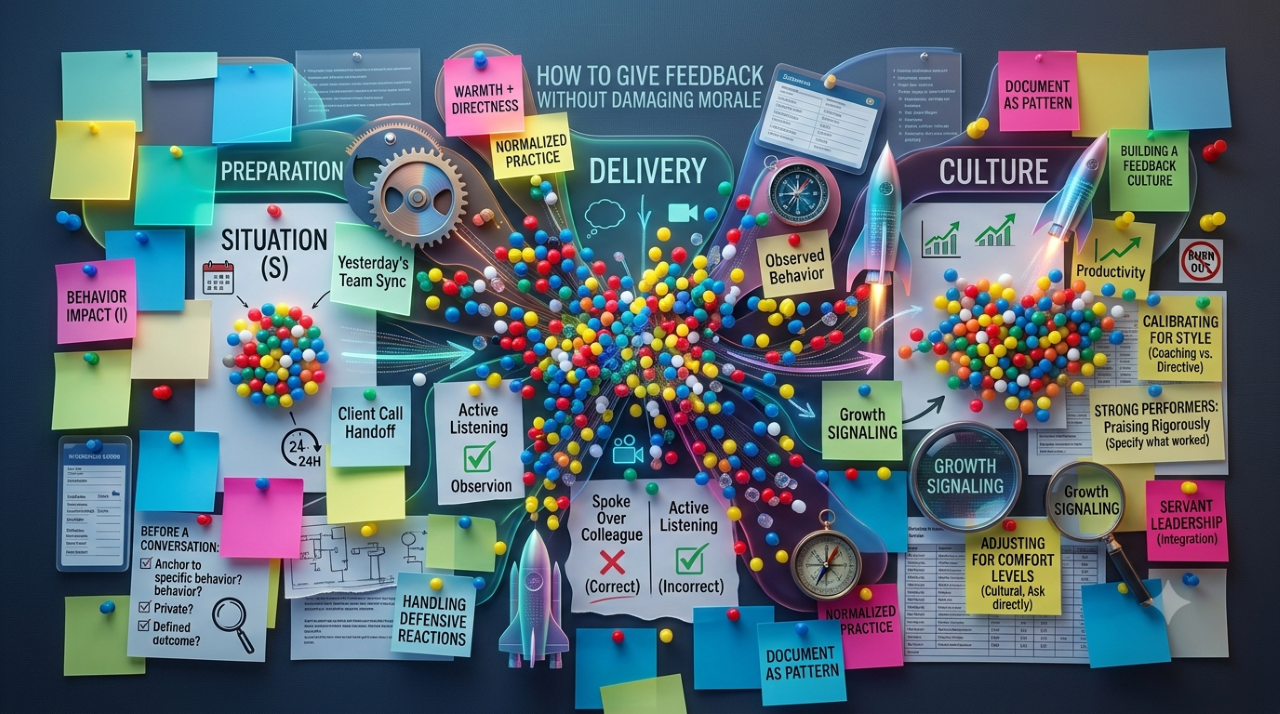
One of the most reliable structures for delivering feedback clearly is known as Situation-Behavior-Impact. The situation names the specific moment or context — “in yesterday’s client call,” for example, rather than a vague reference to a general pattern. The behavior describes what actually happened, in observable terms rather than character terms “you spoke over the client twice while they were explaining their concern,” not “you were being rude.” The impact explains what effect that behavior had “it seemed to frustrate them, and we lost a few minutes re-explaining what they’d already said.”
This structure works because it keeps feedback anchored to something concrete the person can recognize and adjust, rather than a general impression that’s harder to accept or act on. It also happens to make defensive reactions less likely, simply because there’s less room to argue about facts than about character.
Caring Personally, Challenging Directly
A useful second lens is asking whether a given piece of feedback demonstrates genuine care for the person while still being direct about the issue at hand. Feedback that’s direct without any warmth tends to land as an attack, and people rarely absorb useful information while feeling attacked. Feedback that’s warm without real directness sometimes described as ruinous empathy avoids the actual issue to spare someone’s feelings in the moment, which usually just delays a harder version of the same conversation later.
The goal is holding both at once: clear enough that there’s no ambiguity about what needs to change, delivered in a way that makes plain the manager genuinely wants the person to succeed rather than simply wants to be right.
What This Looks Like in Practice
A specific, well-timed comment pointing out that a report sent earlier in the week had a discrepancy between a data table and its summary, and asking to walk through it together before it reaches a client gives someone something concrete to act on immediately. A vague comment urging someone to “be more careful with your work” doesn’t, because it never specifies what carefulness would actually look like in that instance.
Timing matters nearly as much as wording. Corrective feedback delivered privately, and within a day or two of the relevant behavior, tends to be received far better than the same feedback raised weeks later during an unrelated conversation, or raised in front of the rest of the team, where it inevitably carries a public-correction weight that wasn’t intended.
A Worked Example: Two Ways to Handle the Same Situation
Imagine an employee who has missed the same recurring deadline three times in six weeks. One manager waits until the fourth miss, then raises all three prior instances at once in a tone that’s noticeably sharper than usual, catching the employee off guard with the accumulated weight of frustration that had been building quietly for weeks. The employee leaves the conversation feeling ambushed, unclear on which specific behavior actually needs to change, and uncertain whether the relationship has been damaged.
A second manager raises the first missed deadline within a day of it happening, using the Situation-Behavior-Impact structure: what was due, what specifically happened, and what effect the delay had on the rest of the team’s timeline. When the pattern repeats a second time, the manager references the earlier conversation directly and asks what’s actually getting in the way surfacing, in this case, an unclear handoff process the employee had been quietly struggling with rather than any lack of effort. The third instance never happens, because the real obstacle got named and addressed after the second conversation rather than the fourth.
Both managers eventually would have noticed the same pattern. Only one of them treated feedback as a tool for solving the underlying problem early, rather than a consequence delivered once frustration had built past a threshold.
Handling Defensive Reactions
Even well-delivered feedback sometimes triggers defensiveness, and that reaction alone isn’t necessarily a sign the feedback was handled badly. Giving the person room to respond, rather than immediately arguing back, tends to de-escalate faster than pushing the point harder. Asking something like “how do you see it?” before assuming resistance often surfaces context a manager didn’t have a dependency that wasn’t visible, an instruction that was genuinely ambiguous, a conflicting priority from elsewhere. When emotions are running noticeably high, pausing the conversation and returning to it once things have settled usually produces a more productive outcome than pushing through in the moment.
This becomes especially delicate when the person on the receiving end is someone a manager used to work alongside as a peer, where the history adds extra weight to what would otherwise be a routine correction. Our First-Time Manager Guide covers this particular transition in more depth.
Building a Feedback Culture, Not Just Feedback Moments
Feedback tends to land better when it’s a regular habit rather than a rare, high-stakes event reserved for serious problems. Managers who give feedback frequently, including small, low-stakes recognition alongside occasional correction, normalize the practice enough that a harder conversation doesn’t arrive as a shock out of nowhere. Structured one-on-one meetings are one of the easiest places to build this rhythm, since they create a recurring, expected space for exactly this kind of exchange rather than forcing every piece of feedback into an ad hoc, unscheduled moment.
It’s also worth calibrating a feedback approach against a manager’s natural leadership style. A coaching-oriented manager might lean on questions to guide someone toward their own realization, while a more directive style may need to consciously add warmth to keep feedback from landing as pure criticism, even when the intent behind it is constructive.
When Feedback Needs to Be Documented
Most day-to-day feedback doesn’t need a paper trail, and creating one for every minor comment tends to make a manager seem more focused on covering themselves than on actually helping someone improve. That changes once a pattern has repeated enough times that it could plausibly lead to a formal performance conversation, a performance improvement plan, or a decision about someone’s continued role on the team. At that point, a brief written record — what was discussed, when, and what was agreed protects both the manager and the employee, since memory alone becomes an unreliable and easily disputed record once real consequences are on the table.
The shift from informal to documented feedback doesn’t need to feel like an escalation if it’s introduced honestly. Telling someone directly that a conversation is being noted, and why, tends to land better than documentation that happens invisibly in the background the goal is accuracy and fairness, not building a case without the other person’s awareness.
Feedback for Strong Performers Deserves the Same Rigor
It’s easy to assume that a team’s strongest performers need feedback the least, since their work rarely triggers the urgency a struggling performer’s mistakes do. In practice, high performers often receive the vaguest feedback of anyone on a team — a steady stream of general praise with little specific detail about what, exactly, is working well or where there’s still room to grow. Over time, this can leave a strong performer feeling under-coached and, in some cases, more likely to look elsewhere for a role that engages with their development more seriously.
Applying the same Situation-Behavior-Impact structure to praise, not just correction, closes this gap. Naming specifically what someone did well and the effect it had rather than a general “great job” — gives even a strong performer something concrete to keep doing deliberately, and signals that their growth is still being actively considered rather than assumed to have plateaued simply because current performance is already strong.
Adjusting for Different Comfort Levels With Direct Feedback
Not everyone on a team responds to the same degree of directness the same way, and this often traces back to cultural background, prior work environments, or simply individual temperament. Someone who grew up in a workplace culture where indirect, heavily cushioned feedback was the norm may experience even well-structured Situation-Behavior-Impact feedback as unexpectedly blunt, while someone from a more direct environment might find the same feedback frustratingly vague and wish the manager would simply say what they mean.
There’s no universal fix for this beyond paying attention to how a given person actually responds over time, and adjusting accordingly rather than assuming a single approach will land the same way with everyone. Asking directly, early in a working relationship, how someone prefers to receive feedback — some people will have a genuine answer, and even those who don’t will appreciate being asked often prevents months of feedback that technically follows a good framework but still consistently misses the mark with a particular person.
Giving Feedback When You’re Not in the Same Room
Feedback delivered over chat or email carries risks that don’t exist in person, mainly because tone is far easier to misread in text than in a conversation, and there’s no opportunity to notice a confused or hurt expression and adjust in real time. Anything with real emotional weight a correction, a difficult pattern, anything beyond routine praise is usually better delivered over video or in person, even if that means waiting a day for a call rather than sending a message immediately.
When written feedback is genuinely necessary, because of time zones or scheduling constraints, erring toward more explicit warmth than would feel natural in person helps compensate for the tone that’s lost in text. A message that would sound appropriately direct read aloud can land as unexpectedly harsh on a screen, stripped of the vocal cues that would have softened it. Reading a written piece of feedback back before sending, specifically asking whether it could be misread as harsher than intended, catches a surprising number of messages worth softening before they go out.
Common Misconceptions About Feedback
A frequent misconception is that feedback is primarily about correcting problems, which leads many managers to only speak up when something has gone wrong. In practice, the same structure applies just as usefully to recognition naming a specific behavior and its positive impact is exactly as valuable as naming a negative one, and teams that only hear from their manager when something’s wrong tend to become quietly guarded rather than genuinely receptive.
Another common misconception is that more frequent feedback is automatically better, regardless of quality. Frequency without specificity just produces noise a team learns to tune out. A single well-structured, well-timed piece of feedback tends to do more than a stream of vague, generic comments delivered daily out of a general sense that feedback should happen often.
A third misconception is that a manager needs to feel completely confident before giving feedback, which causes many to delay difficult conversations indefinitely while waiting for a certainty that rarely arrives. Feedback delivered with appropriate humility acknowledging you might be missing context, and inviting the other person’s perspective tends to land better than feedback delivered with false confidence, and it doesn’t require waiting for perfect certainty to begin.
A Quick Checklist Before a Difficult Feedback Conversation
- Is the feedback anchored to a specific situation and behavior, rather than a general impression?
- Has enough time passed to think clearly, but not so much that the moment has lost its relevance?
- Is this conversation happening privately, rather than in front of others?
- Do you know what outcome you’re hoping for a changed behavior, a clarified expectation, an open question before you start?
Where to Go From Here
If feedback conversations currently feel uncomfortable or infrequent, start with one upcoming conversation: structure it with Situation-Behavior-Impact, aim for both clarity and warmth, and treat it as the first of a habit rather than an isolated event. That single practice, repeated consistently, does more for team performance than almost anything else on a manager’s plate. For more frameworks like this one, subscribe to our newsletter.
This article is part of our Leadership Fundamentals series. Related reading: What Makes a Good Manager?, First-Time Manager Guide, and Delegation 101.